
'2001: A Space Odyssey'
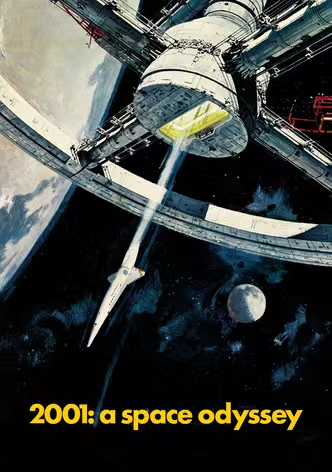
Bill and Sean open up the pod bay doors with director Steven Spielberg to revisit one of the greatest films of all time, Stanley Kubrick's '2001: A Space Odyssey' starring Keir Dullea, Gary Lockwood, and William Sylvester.
Cast
Keir Dullea as Dr. David Bowman
Gary Lockwood as Dr. Frank Poole
William Sylvester as Dr. Heywood R. Floyd
Douglas Rain as HAL 9000 (voice)
Daniel Richter as Moonwatcher (lead ape)
Directed by: Stanley Kubrick
Written by: Stanley Kubrick, Arthur C. Clarke
Cinematography by: Geoffrey Unsworth, Douglas Trumbull
Notes
- Special-occasion pod: Bill and Sean record a full Rewatchables episode with Steven Spielberg, in person, at Bill's house, with cameras rolling. Sean: 'this is your second podcast where there's a couple of cameras around ever' (Spielberg's first was the Big Picture). The official kickoff to the show's 'From Hell' summer gimmick — Bill cheats it in by labeling 2001 'the computer from Hell' (HAL). Released June 1st 2026; 'From Hell' month/and-a-half includes Single White Female next week, plus Hand That Rocks the Cradle, The Good Son, Pacific Heights, Domestic Disturbance, and more — all on Netflix.
- Spielberg's origin story for the movie: spring 1968, freshman/sophomore at Long Beach State, drives with three or four college friends to a big Hollywood movie palace (he believes the Pantages) the first week the movie opens. Walks 9 blocks from parking, waits in line outside while cops keep marijuana off the boulevard. Inside the theater is 'as thick as a London fog' with weed smoke. Then 'Also Sprach Zarathustra' hits its tremendous chord 'and it shut everybody the F up.' Spielberg, a teetotaler who didn't even smoke pot, says he was 'completely intoxicated by what I experienced. It wasn't a film. It was an experience.' Goes back four times in a month. Got his Universal TV-director contract the next year (1969).
- Spielberg on his pod stargate moment in the theater: 'Several people got up and started walking into the screen. The screen was so big — they were vertical strips of reflective material — and a couple of them were reported to have walked actually into the screen and disappeared backstage.' Bill confirms via Arthur C. Clarke's account that 241 people walked out of the New York premiere; Clarke thought it was a disaster. Bill's parallel: a lot of people walked out of the Goodfellas sneak preview too (Brian De Palma was there).
- 1968 frame of reference: Planet of the Apes opened five days BEFORE 2001 (very twinned, both heavily ape-centric — Spielberg notes Apes outgrossed it initially but maybe not over time). Same year as Rosemary's Baby and Bullitt. 'Number one tumultuous year' — Vietnam raging, RFK and MLK assassinations. Sean: 2001 is 'kind of a retreat from that, but also kind of a call to the self.'
- How Spielberg met Kubrick (1980): Spielberg was about to build the Well of the Souls set on the same Pinewood stage where Kubrick had just finished shooting The Shining (the Overlook Hotel grand room with the double staircase, fireplace, and typewriter). Stanley happened to be there doing his own still photographs with a periscope-lens camera and a tabletop model. Doug Twitty, Raiders' production manager, walked Spielberg over; Stanley only wanted to talk about Spielberg's TV movie 'Duel'. Stanley invited him to dinner that night to meet Christiane and Jan Harlan and Stanley's daughters. The relationship grew from there — phone calls, faxes, the eventual handover of AI.
- Stanley as a New Yorker (Sean's running point): he sounds like a WFAN caller — he's loomed over film history as this great intellectual and powerhouse, but he's really just a fast-talking New Yorker. Spielberg's mythbusting on Stanley as a recluse: 'He was not a recluse. The most unfair thing about Stanley's reputation is people think he's like Howard Hughes. Stanley used the telephone. If he'd been born now, he'd have reinvented the iPad and the iPhone to his visionary needs.' Stanley would just call directors whose movies he liked out of nowhere.
- Famous Stanley call: Albert Brooks called Spielberg one day asking 'did you give Stanley my phone number?' — yes, because Stanley asked. Why? 'Because he called me at 3 in the morning to tell me how much he loved Lost in America.' (Stanley was in England, where times-of-day weren't really his thing.) That started a real Brooks-Kubrick friendship.
- AI handover (per Spielberg): Stanley actually asked Spielberg to direct it for him to produce. After about six months of Stanley sending many faxes and storyboards trying to direct it through him ('hey, it'd be great if you put the camera here'), Spielberg pushed back: 'Stanley, let's reverse roles. I'll co-produce with you and you direct it because this is your baby.' Stanley agreed. Then he got distracted by Eyes Wide Shut and tragically passed in 1999. Spielberg sees the throughline as Stanley's preoccupation with 'machine learning and machines teaching machines to teach machines' — the same fear that drives HAL.
- On 2001 itself being misremembered: nobody on this show is going to tell the story of what they meant. Spielberg loves the mystery — he doesn't think Stanley was being literal in the famous 1980 Kubrick phone-interview where he said Bowman was put in a 'human zoo' by 'God-like entities of pure energy' and sent back to Earth as 'some kind of super being.' Spielberg's read: 'I'd like to think Stanley said that because it's exactly what the movie does NOT mean — he's throwing the world off so he can keep the truth a little more concealed.' Bill: 'He's playing a little chess.' Spielberg: 'Oh, he was a great chess player.'
- Best computer-chess gift Spielberg ever gave Stanley: in the '80s, the first tabletop electronic chess game. Stanley called him back a week later: 'Couldn't you have sent me a smarter one?'
- Kubrick's gift / non-narcissist clause: Polanski once asked Stanley if he'd ever taken drugs. Stanley said he never had and never would because 'he didn't know the source of his creative gift and didn't want to fuck with it.' Spielberg loves the line — 'most film makers are shy about even confessing they have any gift at all.' Spielberg paints models with Guillermo del Toro at del Toro's house every weekend; nobody in that room calls themselves a genius even when they think the others are. 'There's nothing harder I can imagine except raising children than my profession.'
- Inside the takes: Spielberg averages 6-8 takes. The Anthony Hopkins / Amistad story: Hopkins came over before the shoot and said 'take 1, I'm getting a feeling. Take 2, I'm going to nail it. Take 3, you can use parts of it. After take 3, you're not going to want to use any of those takes.' Tony's 'choices are almost gifts — intuitive.' Leo DiCaprio (on Catch Me If You Can) likes to watch his own takes back at the monitor and ask for one more — Spielberg waits for Leo to tell him when he's got it. Bill's Nicholson / A Few Good Men sidebar: Jack stayed in the courtroom set even after they offered him a stand-in, just to keep doing it.
- On Stanley's process (per the famous Arthur Clarke letter to his agent): 'I get up at 7 AM, hit the studio by 8:15, generally end around 8:30 PM, go home, say goodnight to the children, work on the novel and go to bed around midnight. I do this seven days a week.' Spielberg: 'That's like me prepping for pods, yeah.'
- Production techniques Spielberg fanboys over: (1) Front projection in the Dawn of Man — Stanley got Scotchlite material that returns light at F11/F16 from a projector mounted next to the camera lens. The leopard's eyes give it away because they catch and reflect the light. Spielberg used the same Scotchlite tech for the cloud-tank lightning in 'Close Encounters'. (2) The floating pen: a slowly-motorized rotating circular glass with double-sided tape (just invented at the time) holding the pen — the pen 'pops' off when the flight attendant grabs it. (3) Weightless pod work: Bowman is on a wire that comes straight out of the camera lens, hidden by a Vaseline blur (no digital wire removal yet). (4) Centrifuge: an entire set physically rotating 360° while the actor walks in place — Spielberg later borrowed it for Joe Beth Williams in Poltergeist. (5) Jogging in the centrifuge: same physical rotation. (6) The blacked-out stars: an entire department painting black over white stars to create occlusion when ships passed in front. (7) Slit-scan photography for Stargate (Doug Trumbull and Kubrick).
- Spaceship lineage per Spielberg: the Jupiter mission spacecraft is what inspired Ralph McQuarrie and Spielberg himself to design the mothership for Close Encounters; it inspired George Lucas's Imperial Star Destroyer; and it inspired Ridley Scott's Nostromo on Alien. 'These wouldn't have existed unless Stanley had come first.' On the Clavius landing-shuttle elevator: Spielberg sees an Egyptian sculpture (two eye-windows, flat-nose center). He once asked Stanley about it; Stanley answered with a question: 'Is that what you think it looks like?' Wow.
- Sound and music: Stanley hired Alex North (his Spartacus composer, one of the greatest film composers ever) to write a 2001 score, then quickly threw it out because 'it turned the movie too much into a movie.' Replaced it with needle drops: Aram Khachaturian (the Adagio from Gayane for the jogging scene), Penderecki, György Ligeti, Strauss (both — Richard for Zarathustra, Johann for the Blue Danube). Did not get permission from the Getty estate / publishers in advance — settled it after. Bill: 'The most New York thing he did was just use the music and didn't tell some of those people. Like — I'm Stanley Kubrick. I'm going to use your music. We'll figure it out later.'
- On the jogging scene specifically (cut by ~2 minutes): 'The point is he's creating a state of mind for the audience to start to accept things.' Spielberg's read on the whole movie's tempo: 'You don't lean forward at that moment. You sit back. I was thinking how long is this shot going to go on. When there was no point of it, the joke was on me.'
- Critic split / opening-week box office: opens to mixed-but-mostly-okay business; Pauline Kael famously calls it 'the biggest amateur movie of them all, only one hour's worth of a good movie here.' LA Times loved it. Roger Ebert: 4 stars. Then MGM marketing — not Stanley, per Spielberg — slaps 'THE ULTIMATE TRIP' on the posters and the psychedelic generation embraces it. Stanley told Spielberg later he doesn't think the movie itself is a drug-trip movie; Spielberg's read: 'The film itself is a drug. You don't need to smoke marijuana to get off on 2001.'
- Kubrick's Oscar: only one he ever won, for Special Visual Effects (which Spielberg argues should also have gone to Doug Trumbull). Best Picture that year went to 'Oliver!' (with the exclamation point). Stanley was nominated for Director, Screenplay, Art Direction. Spielberg's just-one-Oscar pick: Best Director and Best Picture. Spielberg's own apex per Bill: 1982 (E.T. + Poltergeist same summer).
- Casting near-misses: Sterling Hayden was Kubrick's choice for Heywood Floyd — MGM vetoed. Henry Fonda, George C. Scott, William Holden also considered. Spielberg loves the Holden idea: 'It would be like Janet Leigh in Psycho — front-loading a movie that needs to start with a clean slate.' Robert Shaw was looked at for Moonwatcher (the lead ape). Martin Balsam was rejected as the voice of HAL — too 'New Yorkish' (Spielberg agrees: 'Yeah, that's a little New Yorkish'). Pink Floyd was approached to do music — turned it down due to other commitments. Years later they put a monolith on the cover of 'Who's Next' (the Who, who Bill mentions had also approached Kubrick about directing 'Tommy' — he said no because he was doing 'A Clockwork Orange').
- Spielberg memorabilia tangent: he saves everything from his own films in an archive (currently the Jaws set memorabilia is on display at the Academy Museum). Single greatest piece he owns is NOT from one of his movies — he owns Rosebud, the sled from Citizen Kane. Sean saw it in his old LA office before the family moved to New York full-time as of January 1, 2026. He also bought David Bowman's 2001 spacesuit and donated it to the Academy Museum. Per the show's research, Peter Jackson owns HAL's prop eye.
- The Shining anecdote: After Raiders, Stanley took Spielberg out to dinner and asked what he thought of The Shining. Spielberg said he liked it; Stanley said 'no you didn't' and pulled the truth out of him: Spielberg loved the topiary animals and the boiler-room ending in the book and missed them; he thought Jack was 'big.' Stanley made him name his top-10 favorite actors of all time on the spot — when he was done, Stanley said 'where's Cagney? If James Cagney isn't at the top of your list, you're not going to understand what Jack and I did with this character. End of conversation.'
- Disclosure Day (Spielberg's next): opens June 12, 2026 — twelve days after this episode. 'I've been actively interacting in secret with extraterrestrials for eight or nine decades' is the kind of joke he can riff because the movie sits on UFO disclosure. Spielberg promises Bill he'll come back for a Jaws Rewatchables — the deal: Bill has to do his Quint-getting-eaten impression on tape, and Steven wants to see it.
- Spielberg double-feature pick: George Pal's 'Destination Moon' (~1950–52). 'The first breakthrough movie that makes an audience actually believe that someday we will be able to land on the moon.' Sean: 'Destination Moon is finally being issued on Blu-ray in June.' Sean's pick: 'A.I.' (the most direct lineage). Bill's pick: Spielberg's own 'Disclosure Day' (June 12).
- Janusz Kaminski connection: one of the astronauts HAL kills is named 'Kaminsky' — Bill jokes he was a soccer dad with Spielberg's longtime DP Janusz Kaminski for years (and his wife/daughter Helena). Spielberg told Janusz: 'do you know you're in 2001?'
- Half-assed-research grab bag: stuntman almost asphyxiated because they forgot to put air holes in his suit; the Ferris wheel set cost $750,000 (huge line item on a $10M budget); 205 special effects shots; the Getty estate music permissions had to be settled retroactively. Plus: Samsung used 2001 in court vs. Apple as prior art for the tablet. The dead horse painted as a zebra for the leopard scene started to smell after a few days.
- The 2010 sequel ('2010: The Year We Make Contact', 1984): Spielberg is not a fan. 'I really wanted to be left in my imagination when the Star Child turns and looks at the planet Earth. I just wanted to leave it at that.'
Categories
Quote from Rog's review:
“The film creates its effects essentially out of visuals and music. It is meditative. It does not cater us. It wants to inspire us, enlarge us.”
Bill: 'He, he loved it.' One of the cleanest 4-star reads on the show. Pauline Kael famously panned it as 'the biggest amateur movie of them all, only one hour's worth of a good movie here'; the LA Times reviewer loved it. So a clear critical split right out of the gate.
- Spielberg (winner): The lip-reading sequence in the EVA pod — Bowman and Poole rotate the pod, kill the comms, talk about disconnecting HAL — and Stanley cuts to HAL's eye, which has been reading their lips the whole time. 'I didn't see it coming. I must say, like Bowman and Poole, I did not see that coming.' Bill: 'They didn't use the NFL coaches play-sheet covering the mouth.' Sean: 'Bowman's play sheet — he forgot what they were supposed to be running.' Stanley strategically placed the cut to HAL's eye right before the intermission card. Maximum impact.
- Spielberg's other top pick: HAL's death scene — Bowman manually disconnecting HAL's higher functions while HAL pleads ('I'm afraid, Dave. Daisy, Daisy'). 'Of course I love that.' His favorite VFX scene is the Stargate (the slit-scan sequence by Doug Trumbull). 'It's out of control even now.'
- Bill's pick: the ape in slow motion learning how to use the bone as a weapon (also doubles as his Great Shot Gordo).
- Sean's pick: the Clavius monolith landing — the selfie moment, then the Sonic shriek hits the astronauts' helmets and Stanley puts the camera on their shoulders. 'It turns into a horror movie. It's the most Hitchcockian thing in here.' Then the silence-into-Jupiter-mission cut comes through and the giant ship enters frame ('I think it inspired George to do the first shot of Star Wars').
- Spielberg connects the Clavius shriek-into-silence-into-Jupiter beat: 'It hurts the audience's ears. Then it's quiet. And then this huge ship comes in. And that's also Stanley's conceptual audacity.'
- Other A+ scenes Bill walks through: Dawn of Man with the leopard jumping out (real leopard, guy in a gorilla suit — Spielberg: 'I hope the guy in the gorilla suit got a stunt adjustment'); the bone-to-spaceship match cut into the Blue Danube; Floyd's Russian-summit at the Hilton 5 (the engineered cover-story Spielberg later openly stole for the Foz Gene gas at Devil's Tower in 'Close Encounters'); the buried lunar artifact selfie and shriek; HAL trapping Poole and the slow drift away in the EVA pod; the Stargate approach; the white-room final stages-of-life sequence and the Star Child.
- Spielberg's actual answer: nothing about 1968 makes it into 2001. 'There was no 1968. Whatever the year stood for, whatever was relevant about that year — for two and a half hours it's irrelevant while you're watching.' Bill rewords as the most-1968 thing being the way the movie steps OUTSIDE of 1968.
- Bill's pick: the intermission. 'Nobody would do that anymore.' Plus opening with three minutes of a black screen and Ligeti music. Sean: 'It doesn't say overture, doesn't present that we're all going to sit here quietly. It just starts.'
- Spielberg's roadshow-presentation context: Lawrence of Arabia, Ben-Hur, Doctor Zhivago, West Side Story all opened with overtures and exit music. 'It said this is going to be more bang for your buck. It's a single-bill experience. It's one night, like going to a play. There's going to be a prologue, a long main title, an intermission, and a play-out medley as you leave.'
- Sean: the idea that 2001 was a 'long ways away' is itself extremely 1968. We're now 25 years past it.
- Sean (broader): a movie made entirely without digital effects in which handmade tools are used to explore a film about man discovering the utility and danger of those tools. 'There are no films of this scale made entirely by hand anymore.'
- The marketing line 'THE ULTIMATE TRIP' is also a peak-1968 artifact (and per Spielberg, that's MGM marketing, not Stanley).
- Spielberg (winner): HAL 9000. The single most age-the-best thing in the movie. 'This is probably the easiest what's-aged-the-best we have.'
- Sean's longer list: the sci-fi blockbuster as a Hollywood staple, video phones, voice-print identification, artificial intelligence, video tablets (Samsung literally cited the movie in court vs Apple as prior art for the tablet), zero-gravity toilets, brand placement everywhere, the growing belief that alien life exists, the Minority-Report style mysterious-government-cover-up of something unsettling, famous people watching videos of themselves (the news segment about the astronauts is a perfect social-media foreshadow), and the foreboding-mysterious Kubrick style itself.
- Bill: pulling off no dialogue in the first 25 minutes and the last 23 minutes — 'I can't imagine anyone even trying to pull that off now.' Plus the solo-astronaut-traveler movie gimmick that became 'The Martian' / 'Project Hail Mary'. Plus David Bowie's 'Space Oddity' (1969) is a direct response to this movie.
- The whole moon-landing thread: Stanley films outer space, then a year later Apollo 11 lands. The conspiracy that Kubrick filmed the moon landing — Spielberg thinks Stanley LOVED the conspiracy. 'He was great inside of a joke. I think he would love that.' Stanley plays into it himself in The Shining (Danny's Apollo 13 sweater) — fans have run with it for decades.
- The choice of using classical music over an original score (Khachaturian, Ligeti, Strauss, Penderecki) instead of the Alex North original — 'best using classical music over a real score.'
- Bill's pick (Great Shot Gordo): the lead ape in slow motion learning how to use the bone as a weapon — the Strauss-scored discovery. Followed by the bone-to-spaceship match cut.
- Sean's pick: the floating pen — Spielberg seconds it: 'You just took my answer.' Mechanism: a slowly-motorized rotating circular glass with the pen attached via newly-invented double-sided tape; you can see it 'pop' off when the flight attendant grabs it.
- Spielberg's other pick: the Dawn of Man front-projection composites. Wally Veevers's team used Scotchlite material so reflective you could read F11/F16 off it; the only giveaway is the front-projector reflection in the leopard's eyes — that's why the leopard's eyes look so animated.
- Bill (winner): the opening credits with 'Also Sprach Zarathustra' (Strauss). Spielberg: 'Oh, by far. You named it.'
- Plus the Blue Danube waltz over the bone-to-spaceship match cut into the docking-with-the-space-station sequence — 'completely relaxes you into accepting the possibility of a future like this.'
- Khachaturian's Gayaneh (the Adagio) under the Jupiter-mission jogging in the centrifuge.
- Ligeti's atonal 'Lux Aeterna' / 'Requiem' / 'Atmosphères' for the monolith encounters.
- Bill's only weak-link target is the intermission as a 1968-only feature (more a 'year it came out' than a real flaw). Spielberg refuses a real weak link: 'It's almost a perfect film.'
- Bill's small one: the BBC 12 line. Stanley joked that England would surpass the US in the future; Bill's research counts only ~11 BBC channels in 2026 (BBC 1/2/3/4, BBC News, BBC Parliament, CBBC, CBeebies, BBC Scotland, BBC Alba). 'So he was wrong. Sorry, Stanley. Eleven short.'
- Pan American Airways (the Pan Am shuttle to Hilton 5) — Pan Am no longer exists. Bell Telephone — gone. Howard Johnson's — barely. Spielberg: 'You've got a lot of things that don't exist anymore where the film has outlived what I think Stanley assumed would be around for millennia.'
- The 2010 sequel ('2010: The Year We Make Contact', 1984): Spielberg explicitly does not love it. 'I really wanted to be left in my imagination when the Star Child turns and looks at the planet Earth.' Bill agrees.
- The intermission as a feature of the moviegoing experience.
- Sean: 'The idea that we could shut down AI maybe under some debate right now.' Spielberg lifts the discussion to his 'Ready Player One' ending — the kids agree to close the Oasis two days a week so people can connect with each other again.
- Spielberg's 'and now my kids are going to hate me for that': the phone is the 21st-century Oasis.
- Bill: 'We did land on the Moon. But they also had Stanley Kubrick film, or used spaced-up footage, just because they couldn't have actually shown video, and they did the hybrid model.' (i.e., real landing + Kubrick-shot supplementary material.) Spielberg: knowing Stanley as little or as much as he does, 'I think he would love' people thinking he faked the moon landing.
- Sean: this movie might be #1 for the inverse of homages — i.e., people borrowing FROM it. 'There are inspirations and parodies up the wazoo — Simpsons multiple times, Mad Magazine, Airplane II.' The actual stealth homage IN the movie is Kubrick winking at himself: in Doctor Strangelove Major Kong says 'fire the explosive bolts'; in 2001 the entry-hatch sign reads 'Caution: Explosive Bolts.' Spielberg, who'd never spotted it: 'I never in the history of the category — that one insight makes my day.'
- Heywood Floyd: Kubrick wanted Sterling Hayden, MGM vetoed. Henry Fonda, George C. Scott, and William Holden also considered. Spielberg defends Holden: 'It would be like Janet Leigh in Psycho — front-loading a movie that really needs to start with a clean slate.'
- Moonwatcher (the lead ape): Robert Shaw was reportedly considered. ('Now what — where are these facts from?' Spielberg double-checks. Bill: 'They're half-assed internet research.' Spielberg: 'OK, you'll wink at me if it's urban legend.')
- HAL: Martin Balsam rejected for being 'a little too New Yorkish.' Spielberg agrees.
- Music: Pink Floyd was approached, turned it down due to other commitments. Spielberg: 'Brilliant of The Who to tap into Stanley for that' (re: the unrelated Tommy approach right after).
- Stars in general: Bill floats Steve McQueen → Spielberg first says it'd take you out of the movie because of 'too much baggage' (BLOB to Bullitt the same year), then talks himself into it: 'a good actor is supposed to become an anonymous character… maybe Steve could have done 2001. I'm going to back it up. McQueen in 2001. But maybe Hackman could have done it.'
By design, Kubrick wanted ONLY 'that guy' faces — no movie stars. Keir Dullea (David and Lisa, 1962) and Gary Lockwood were both cast precisely because they didn't bring filmography baggage. William Sylvester was an American doing British stage; nobody in America had really seen him. So in a sense the entire principal cast IS this category.
- Bill (winner): HAL — 'comes in hot for like 10-15 minutes' and runs the second half of the movie. Douglas Rain's voice doing all the work.
- Sean: Daniel Richter as Moonwatcher, the chief ape. 'That's an amazing performance' — under prosthetics with no dialogue.
- Spielberg (his pick): Vivian Kubrick as Squirt, the Bush-Baby-asking child of Heywood Floyd. (Sean's #2 too.)
Bill: 'We wouldn't put any name actors in this.' Spielberg: 'No, we wouldn't. No.' This category basically dies on contact — the whole movie is built around having no name actors, and recasting would defeat the purpose.
- $10M budget (Kubrick negotiated up from $4.5M). 205 special-effects shots — 'a poultry amount compared to a streaming movie on Netflix today,' per Spielberg.
- Released April 2, 1968 (five days after Planet of the Apes, which initially outgrossed it). Won Kubrick his only Oscar — Special Visual Effects. Best Picture went to 'Oliver!'
- 241 walkouts at the New York premiere, including Rock Hudson, who left early muttering 'will someone tell me what the hell this is all about?' Arthur C. Clarke thought the premiere was a disaster.
- Marketing turn-the-tide: MGM (not Stanley) put 'THE ULTIMATE TRIP' on the posters and billboards, capturing the psychedelic generation and saving the box office.
- Shooting trivia: a stuntman almost asphyxiated because they forgot to put air holes in his suit. The Ferris wheel (centrifuge) cost $750,000 — a huge line item on a $10M budget. The Getty estate publishing rights for the music were not granted in advance — settled afterward. A dead horse painted like a zebra for the leopard scene began to smell after a few days.
- The Who approached Kubrick about directing 'Tommy' after this — Kubrick said no because he was doing 'A Clockwork Orange.' (The Who later put a monolith on the cover of 'Who's Next' as a wink/jab.)
- Kubrick's archive: per his brother-in-law, Stanley was adamant the 19 minutes of trims would never be seen and burned all the negatives. Spielberg's read: 'What he's doing is striking the sets.' Spielberg himself saves everything in archive.
- Memorabilia map: Spielberg owns David Bowman's spacesuit (donated to the Academy Museum). Per show research, Peter Jackson owns HAL's prop eye. Spielberg also owns Rosebud the sled from Citizen Kane (his single greatest piece of memorabilia, currently in his New York home).
- Gene Siskel anecdote: Siskel loved the movie and asked Kubrick about getting the monolith — Kubrick told him it didn't exist and they threw it away.
- Kubrick was so dissatisfied with the script he approached several other writers, all of whom turned him down. (A great writer himself, per Spielberg.)
- Janusz Kaminski connection: an astronaut HAL kills is named 'Kaminsky'. Spielberg's later DP Janusz Kaminski didn't know about it; Spielberg told him 'do you know you're in 2001?' Bill was a soccer dad with the Kaminskis for years.
- Pinewood / Raiders set / Shining set: Spielberg first met Stanley because Raiders' Well of the Souls was being built on the same stage where Stanley had finished The Shining (the Overlook Hotel grand room).
- Stanley Kubrick: yes. 'This is the movie that made Stanley famous, not just among critics and journalists, but among the public.' Career-juice apex.
- Space movies: yes — 'this was certainly the Big Bang for every single movie about serious science fiction where science is being emphasized, even Jurassic Park, where science creates the credibility for an audience to believe that yes, dinosaurs can come back.'
- Hand-made / practical-effects-driven blockbuster: yes. Spielberg: 'It's a hand-made movie. The last hand-made movie I saw was Guillermo del Toro's Pinocchio.' Sean: stop-motion is the last vestige of the hand-made movie.
- Front-projection composites: yes (and Spielberg used the same Scotchlite tech for Close Encounters' cloud tank).
- Roadshow presentation (overture / intermission / playoff): pretty much yes — this is the late-period peak of that exhibition style.
- Spielberg picks Hanks. 'He made Apollo 13. He's the astronaut guy. If he could be an astronaut, Tom would give it all up to be an astronaut.'
- Sean: actually argues both — Hanks for Heywood Floyd, Cruise for Bowman. Bill floats Cruise as the lead ape ('throwing himself into it for nine months'). Spielberg cosigns: 'I think it'd been cool for any of the movie stars to — look, Daniel Craig was a stormtrooper in Force Awakens.'
Sean: 'This one is a no-brainer.' (Spielberg, sitting at the table.) Bill agrees: 'I think you won this one.' Spielberg pretends to need to clear his palette for it. Even with the man himself in the room, the answer is Spielberg — given his own lineage to the film through Close Encounters, A.I., and Ready Player One.
- Bill: the ape costumes in 4K — 'a couple times it feels like, yeah, that's probably a guy there.' Spielberg counter: they're not apes, they're proto-humans. ('It was the year of the ape — Planet of the Apes opened five days before.')
- Bill: would HAL actually be able to read lips? Spielberg: 'Absolutely. That's a walk in the park for AI.' Sean: 'They're reading our lips right now.'
- Bill: the film never tells you which year it's set — the buried-monolith Clavius scene is supposedly 2001, then we cut to '18 months later' for Jupiter mission. Spielberg's clean answer: '2001 isn't a year. It's about the millennium. It doesn't matter.'
- Sean: if HAL is so advanced, why can't he anticipate Bowman's move to disconnect his higher brain functions? Why not just turn off all the lights and lock all the doors? (No emergency manual override.) Spielberg's read: 'HAL knew, being so sentient, that he was a bad boy and needs to be severely corrected. Like Grady saying to Jack what he should do to his children. HAL knew he needed to be corrected. And at that moment Bowman was Jack Torrance.' Sean: 'Wow, love it.'
- Untouchable, basically. The 2010 sequel exists and Spielberg dismisses it ('I'm not a big fan of the next 2010 movie because I really wanted to be left in my imagination when the Star Child turns and looks at the planet Earth').
- Spielberg as a related case: Stanley actually handed AI to Spielberg. Six months of fax-directing it via storyboards before Spielberg pushed back; Stanley agreed; then Eyes Wide Shut intervened; then 1999. AI was effectively the Kubrick-2001 sequel that became a Spielberg-Kubrick movie.
- Bill's bonus: a Disclosure Day double bill — Spielberg's June 12, 2026 movie sits naturally next to 2001 in lineage.
- The movie is so spare and anti-emotional that the show doesn't work the better-with bit hard. The closest hit is Bill's running 'Steve McQueen could have done it' thread, which Spielberg eventually warms to and then walks back to Hackman.
- Spielberg's substitution philosophy from his own work: 'When I made Close Encounters, I didn't think about putting big stars in there because I wanted the movie to be known and them to become the characters.' E.T. same principle. 2001 took it the furthest.
- Spielberg: Best Director AND Best Picture. (He wants two Oscars; Bill doesn't fight him.) Bonus: Spielberg would also have given Doug Trumbull an Oscar along with Stanley for Special Visual Effects — Stanley was the only one credited.
- The actual 1968 Oscars: nominated for Director, Original Screenplay, Art Direction, won Special Visual Effects only. Best Picture went to 'Oliver!'
- What happens to Bowman after the Star Child? Kubrick (in a 1980 phone interview): 'Maybe he's transformed into some kind of super being and sent back to Earth. We'll only have to guess what happens when he comes back.' Spielberg's read: Stanley said that to throw the world off, not because that's actually what the movie means.
- Why does HAL break down? Kubrick: 'HAL had an acute emotional crisis because he could not accept evidence of his own fallibility.' Bill: 'My take is the two things short-circuited him — supposed to be all-knowing AND smart enough to know he was being lied to.' Spielberg's better read: 'HAL was a complete narcissist. Listen to how he brags about his product, his design, where he was born, that no 9000 has ever made a mistake.' Sean: 'And he is a mirror of the human race that created him.'
- Sean: the ultimate unanswerable — who delivered the monoliths?
- Bill: the first shot of the three astronauts on the moon-monolith scene sure looks a lot like the actual moon landing one year later.
- Bill's signature: did this movie ruin the name HAL? Hal Holbrook, Hal Ashby, Hal Linden — when's the last time you met anyone under 40 named Hal? Sean defends: 'I love the Hal — Falstaff calls Henry V Hal. Harold can be a Hal.'
- Spielberg (winner — never been uttered on the show before): 'I actually bought the one piece of memorabilia I wanted from this movie. I have David Bowman's spacesuit, which I donated to the Academy Museum.' Bill: 'You just trumped that.'
- Sean's pick: HAL's prop eye (which, per Spielberg, Peter Jackson owns).
- Stanley meanwhile, per Gene Siskel anecdote, had told Siskel the monolith 'didn't exist and they threw it away' when Siskel asked about acquiring it.
- Spielberg's Coach Finstock: 'Never ever close your mind off to an impossible possibility.' Bill: 'That's better than mine.' Sean: 'I can't do better than that.'
- Adjacent: Stanley's own life rule (per a Polanski exchange): never take drugs because 'I don't know the source of my creative gift and don't want to fuck with it.'
- Spielberg's own Ready-Player-One-end-credit lesson he tries to live by: take two days a week off from constantly performing your identity online. 'Why can't there be one or two days that we get back down to having picnics outside somewhere?' Sean: 'I wish I could just put my phone in the ocean, but I can't.'
- Spielberg (winner): George Pal's 'Destination Moon' (1950). 'The first breakthrough movie that makes an audience actually believe that someday we will be able to land on the moon — also a tremendous exercise in suspense.' Sean's bonus: Destination Moon is finally being issued on Blu-ray in June 2026.
- Sean's pick: 'A.I. Artificial Intelligence' (2001) — the directly inherited movie from the same cinematic DNA.
- Bill's pick: Spielberg's own 'Disclosure Day' (June 12, 2026). Backup pick: 'The Shining' — pair them as a five-hour Kubrick double 'and see what stuff he took or things you find new.'
- Bill: Stanley Kubrick. Easy. Spielberg agrees.
- Bonus inheritance: every filmmaker after him. Spielberg directly cites the Jupiter mission ship → Close Encounters mothership / Star Wars Imperial Star Destroyer / Alien's Nostromo lineage. 'These wouldn't have existed unless Stanley had come first.'
- Craig (Horlbeck): third time seeing it (first at 19 in film school, then mid-20s, now early 30s). 'My maturity has affected how much I appreciate this movie. When I was 19, I was a little underwhelmed and didn't like the lack of clarity at the ending. I have completely pivoted. The ambiguity, letting yourself use your life experience to inform what you think — that's why I think it's so good.'
- Craig: 'The big synchronized spacecraft sequences with these big musical numbers behind it — when the scenes end and they go to black for a second, these vignettes, you almost want to applaud. It's like you're at a magic show. You turn to the person next to you and you go, wow, how did they do that?'
- Craig (the thing the hosts didn't mention): 'HAL's voice. The choice of HAL's soft but chilling tone makes the entire film. So comforting, but also ominous. There's something beneath it that is chilling.' Sean: 'I thought you would open the pod by saying open the pod bay doors, Steven.'