
March 10, 2026
'Fargo'
CR Month rolls on with a trip to the Twin Cities to revisit Joel and Ethan Coen's 1996 crime thriller 'Fargo' starring William H. Macy, Frances McDormand, and Steve Buscemi.
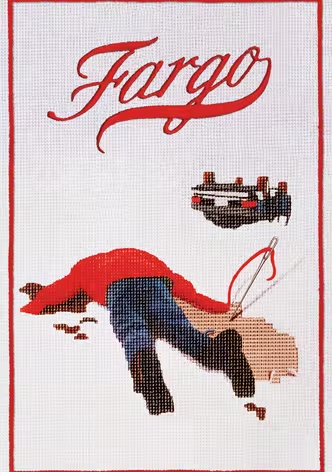
Cast
William H. Macy as Jerry Lundegaard
Frances McDormand as Marge Gunderson
Steve Buscemi as Carl Showalter
Peter Stormare as Gaear Grimsrud
Harve Presnell as Wade Gustafson
John Carroll Lynch as Norm Gunderson
Steve Park as Mike Yanagita
Larry Brandenburg as Stan Grossman
Directed by: Joel & Ethan Coen
Written by: Joel & Ethan Coen
Cinematography by: Roger Deakins
Music by: Carter Burwell
Notes
- $7 million budget, made $60.6 million at the box office. 98-minute runtime.
- 7 Oscar nominations, won 2: Best Actress (Frances McDormand) and Best Original Screenplay. Lost Best Picture to The English Patient. William H. Macy lost Best Supporting Actor to Cuba Gooding Jr. for 'Jerry Maguire'.
- Released March 8, 1996. Siskel and Ebert both named it Best Movie of 1996.
- Bill Pullman was originally cast as Jerry Lundegaard before William H. Macy insisted on the part. Richard Jenkins was also considered for a role.
- A 1997 TV pilot starring Edie Falco as Marge almost derailed The Sopranos – if that had been picked up, David Chase might never have cast her as Carmela.
- Peter Stormare has only 18 lines of dialogue in the entire film, never more than one sentence at a time.
- The word 'yeah' appears 179 times in the script.
- The Paul Bunyan statue was built specifically for the film and dismantled after filming.
- The Coen Brothers have only one film over 2 hours: 'No Country for Old Men' at 2 hours and 2 minutes.
- Kyle calls it a perfect movie. The 'based on a true story' opening is a complete fabrication by the Coens.
- The Coen Brothers edit their own films under the pseudonym Roderick Jaynes.
Categories
Roger Ebert's review
Quote from Rog's review:
“It rotates that story through satire, comedy, suspense and violence until it emerges as one of the best films I've ever seen. Films like Fargo are why I love the movies.”
- CR: Ebert called it one of the best films he's ever seen – that's a huge statement from someone who reviewed thousands of movies.
- Kyle: The fact that Siskel and Ebert both independently named it Best Movie of 1996 tells you everything.
Most re-watchable scene
- CR: The highway triple homicide – Carl and Gaear get pulled over by a state trooper on a dark highway, and it goes from zero to horrifying in seconds. Then two innocent passersby drive up and it gets even worse.
- Kyle: The Mike Yanagita scene at the Radisson. It's so awkward, so specific, and the way Marge processes it changes the whole trajectory of the investigation.
- Bill: Marge interviewing the two call girls at the Eklund & Swedland apartments. 'Oh, he was a little guy... kinda funny looking.' The way the information dribbles out is comedy gold.
The most 1996 thing about this movie
- Bill: 1996 was incredible for movies – 'Fargo', 'Jerry Maguire', Sling Blade, 'Swingers', The English Patient, 'Trainspotting', Scream, 'A Time to Kill', The Cable Guy, 'Primal Fear'.
- CR: This is right in the sweet spot of the 90s indie golden age. 'Pulp Fiction' in '94, then 'Fargo' in '96 – these were the movies that made people think cinema was evolving.
- Kyle: The Coen Brothers had already established themselves with Raising Arizona and Barton Fink, but 'Fargo' is when they became household names.
What aged the best?
- Bill: Steve Buscemi's 90s scumbag run. 'Reservoir Dogs', 'Fargo', 'Con Air', 'The Big Lebowski' – nobody played a weaselly lowlife better.
- CR: Marge and Norm's marriage. They're just eating and lying in bed together and painting ducks. It's the most purely good relationship in any Coen Brothers movie.
- Kyle: The Minnesota snapshot – the accents, the hot buffets, the politeness masking passive aggression. It's a time capsule of a specific American subculture.
- Bill: The accents have aged beautifully. People from Minnesota still talk like that.
Most cinematic shot
- CR: The opening whiteout – Jerry's car emerging from pure white nothingness, just two headlights cutting through the void. Roger Deakins establishing the entire movie's tone in one shot.
- Kyle: The Paul Bunyan statue looming over the landscape. It's simultaneously ridiculous and ominous.
- Bill: The overhead shot of the parking garage where Wade gets shot. The geometry of it is incredible.
Best needle drop
- CR: Carter Burwell's main theme – that Scandinavian folk melody played on hardanger fiddle. It's mournful and beautiful and captures the bleakness of the landscape perfectly.
- Kyle: The score is doing so much heavy lifting. It tells you this is a tragedy disguised as a comedy.
Weak link of the movie
- Bill: It's really hard to find a weak link in this movie. Maybe Scotty, Jerry's son – he has no curiosity about what's happening to his family. His mom gets kidnapped and he barely registers it.
- CR: The movie is so tight at 98 minutes that there's genuinely nothing wasted. If you had to nitpick, maybe the 'true story' framing is a bit of a cheat.
- Kyle: I refuse to name a weak link. This is a perfect movie.
What aged the worst?
- Bill: The 'based on a true story' lie. Once you know it's completely fabricated, it changes how you process the opening. The Coens were just messing with people.
- CR: Hot buffets. The sheer volume of hot buffet references is alarming by modern standards.
- Kyle: The rotary phone on Jerry's bedside table. It's such a specific period detail.
- Bill: Watching it pan-and-scan on cable in the late 90s. You lost so much of Deakins's compositions.
The hottest take award
- Kyle: 'Fargo' is a perfect movie. There is not a single wasted frame, not a single wrong performance, not a single scene that doesn't earn its place.
- Bill: William H. Macy should have won the Oscar over Cuba Gooding Jr. Cuba was great, but Macy's Jerry Lundegaard is one of the all-time performances.
- CR: The Mike Yanagita scene is the key to the entire movie. Without it, Marge doesn't re-examine Jerry, and the whole investigation stalls.
Casting what-ifs
- Bill: Bill Pullman was originally cast as Jerry Lundegaard. Macy had to campaign hard for the role – he told the Coens 'I'm going to shoot your dog' if they didn't cast him.
- CR: Richard Jenkins was also considered. Imagine a version where Jerry is more physically imposing – it changes the whole dynamic of the father-in-law relationship.
- Kyle: What if someone other than McDormand played Marge? She IS that role. You can't separate them.
Over-acting award
- Bill: The Proudfoot scene – the guy doing the TruCoat hard sell. He's in the movie for 30 seconds and he's doing more acting than most people do in their entire careers.
- Kyle: Macy in the phone booth when the plan is falling apart. The sweat, the desperation, the stammering – he's operating at such a high level it loops back around to looking naturalistic.
Best "that guy"
- Bill: Harve Presnell as Wade Gustafson. He's a Broadway musical theater guy who shows up and plays this intimidating Minnesota patriarch. He's terrifying and you believe every second of it.
- CR: Larry Brandenburg as Stan Grossman. 'I'm not gonna debate you, Jerry.' He's the straight man to Macy's increasingly desperate performance.
- Kyle: Steve Park as Mike Yanagita. One scene, and it's one of the most discussed scenes in the entire movie.
Best "heat check" performance
- Bill: The Coen Brothers after 'Fargo'. They followed it with 'The Big Lebowski', then O Brother Where Art Thou, then The Man Who Wasn't There, then 'No Country for Old Men'. Arguably the greatest run any directors have ever had.
- CR: Frances McDormand winning the Oscar for Marge Gunderson, then coming back 20 years later and winning again for Three Billboards. That's a heat check career.
- Kyle: Roger Deakins's cinematography. He shot 'Fargo', then 'The Big Lebowski', then O Brother, then No Country. He was the Coen Brothers' secret weapon.
Re-casting couch
- Bill: Test drive Robert Duvall as Wade Gustafson, the father-in-law. That menacing patriarch energy would be incredible.
- CR: You really can't recast this movie. Every single person is so perfectly matched to their role.
- Kyle: The one thing you absolutely cannot change is the city. 'Fargo' without Minnesota is not 'Fargo'.
Half-assed (internet) research
- Bill: The movie is set in 1987 but released in 1996. I didn't realize that until this rewatch.
- CR: Jerry's whole scheme makes no sense if you think about it for 10 seconds. He's borrowing against cars that don't exist to get a loan he can't repay, and his plan is to split a ransom with the kidnappers? The math doesn't work at all.
- Kyle: Marge just... drives to Minneapolis from Brainerd in the middle of the night? How far is that?
Apex Mountain
- Bill: William H. Macy apex mountain. He was always a great character actor, but Jerry Lundegaard made him a star. Everything after this – 'Boogie Nights', 'Magnolia', Shameless – flows from 'Fargo'.
- CR: Frances McDormand apex mountain. She'd been great in Blood Simple and Mississippi Burning, but Marge Gunderson is the role she'll be remembered for.
- Kyle: Steve Buscemi apex mountain. 'Reservoir Dogs' made him cool, but 'Fargo' made him iconic.
Would this movie be better with...?
- Kyle (doing Gus Johnson voice as Mike Yanagita): Reimagining the Radisson scene with YouTube personality Gus Johnson's energy – 'MARGE! It's so good to see you!'
- CR (doing Zane Lowe voice interviewing Marge): 'Marge, this investigation... it's a MASTERPIECE. Tell me about the moment you knew.'
The most GIFable moment
- Kyle: Steve Buscemi getting fed into the wood chipper. The most iconic image in the entire movie.
- Bill: Macy's face when Wade says he's going to handle the drop himself. Pure panic.
- CR: Marge's 'oh jeez' – the quintessential Minnesota reaction to discovering a triple homicide.
Cruise or Hanks?
Hanks wins
- All three: Hanks. This is a deeply human movie about decent people caught in terrible circumstances. Marge and Norm are the embodiment of Hanks energy – they're good, they're kind, and they don't understand why people do evil things.
- CR: The final monologue about the stamp – 'and it's a beautiful day' – that's pure Hanks. Finding beauty in ordinary life.
Scorsese or Spielberg?
- CR: Scorsese. The violence is sudden and shocking, the criminals are pathetic and doomed, and the whole thing has that Scorsese sense of inevitability.
- Bill: The way the body count escalates – it starts with one trooper and then the dominos just keep falling. That's Scorsese pacing.
- Kyle: The only Spielberg element is Marge herself. She's the moral center, like a Spielberg hero dropped into a Scorsese crime story.
What role would Philip Seymour Hoffman play?
- Bill: William H. Macy in every scene. He's sweating, lying, stammering, and falling apart – and you can't look away.
- CR: Macy scraping ice off his windshield while everything in his life is collapsing. That's the PSH moment – a mundane physical task carrying enormous emotional weight.
Picking nits
- Bill: Why does nobody hear the gunshots on the highway? It's a wide open space in the middle of winter – sound carries forever out there.
- CR: Jean Lundegaard's reaction to the kidnapping is weirdly over-the-top even by horror movie standards. She runs into a shower curtain rod.
- Kyle: Wade just... goes to the parking garage alone with a million dollars to confront kidnappers? He's a successful businessman – that's the dumbest thing anyone does in this movie.
Sequel, prequel, prestige TV or untouchable?
- Bill: They literally did this! The 'Fargo' TV series on FX, and it's actually incredible. Noah Hawley understood that you don't remake 'Fargo' – you use it as a jumping-off point for new stories in the same world.
- CR: Season 1 with Billy Bob Thornton and Martin Freeman is genuinely one of the best seasons of TV ever made. It captures the spirit of the movie without copying it.
- Kyle: The fact that they pulled off a 'Fargo' TV show is one of the most unlikely successes in television history.
Just one Oscar, who gets it?
- Bill: Macy should have won Best Supporting Actor. Cuba Gooding Jr. was great in 'Jerry Maguire', but Macy's Jerry Lundegaard is a top-10 performance of the 90s.
- CR: They should have won Best Picture over The English Patient. That's the classic Oscars getting it wrong.
- Kyle: Macy losing to Cuba is one of those Oscar results that looks worse and worse over time.
(Probably) unanswerable questions
- Bill: What was Jerry's actual plan? Even if everything went perfectly, how was he going to explain his wife's return and the missing money to Wade?
- CR: What is the Mike Yanagita scene actually about? Is it just about Marge learning that people lie, which makes her reconsider Jerry? Or is it something deeper about loneliness in the Midwest?
- Kyle: Where was Carl going to hide that money long-term? Buried next to a fence post on a highway in Minnesota?
What memorabilia would you want (or not want!) from the movie?
- Kyle: A 'Fargo' snow globe – the Paul Bunyan statue in a blizzard.
- Bill: The Gustafson Motors sign from Jerry's dealership.
- CR: One of those cop jackets with the fur-lined hood that Marge wears.
- Kyle: Carl Showalter's driving gloves.
Best (or worst!) life lessons from the movie
- Bill (quoting Marge): 'There's more to life than a little money, you know. Don'tcha know that? And here ya are, and it's a beautiful day.' The whole thesis of the movie in two sentences.
- CR: Don't hire criminals to kidnap your wife. Just... don't.
- Kyle: If your father-in-law is a millionaire and you need money, just ask him directly instead of orchestrating an elaborate kidnapping scheme.
Best double feature for this movie
- Bill: 'No Country for Old Men' – the Coen Brothers' other masterpiece about crime spiraling out of control in a stark American landscape.
- CR: 8mm – another late-90s crime thriller about ordinary people getting in over their heads in a criminal underworld.
- Kyle: Triple feature – Raising Arizona, 'Fargo', 'No Country for Old Men'. The complete Coen Brothers crime trilogy.
Who won the movie?
- Bill: The Coen Brothers won the movie.
- CR: Minnesota won. This movie put Minnesota on the cultural map in a way that nothing else has.
- Kyle: The state of Minnesota. People who have never been there feel like they know it because of this movie.
Producer review
Craig (remote from Indianapolis): Screenwriting is dead. The way the Coens write dialogue – nobody does this anymore. 5 out of 5 on Letterboxd.