
'Marathon Man'
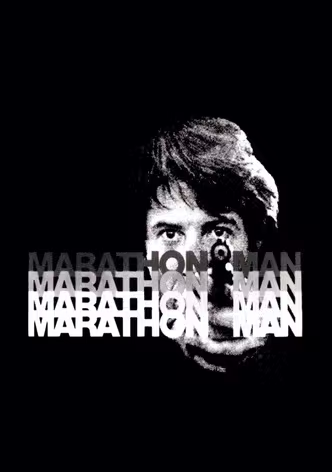
Is it safe? The Ringer's Bill Simmons and Chris Ryan discuss the 1976 crime thriller 'Marathon Man,' starring Dustin Hoffman, Laurence Olivier, and Roy Scheider.
Cast
Dustin Hoffman as Babe Levy
Laurence Olivier as Dr. Christian Szell
Roy Scheider as Doc Levy
William Devane as Peter Janeway
Marthe Keller as Elsa Opel
Directed by: John Schlesinger
Written by: William Goldman
Cinematography by: Conrad Hall
Notes
- Part of New York City Month on The Rewatchables.
- Pauline Kael called this 'a Jewish revenge fantasy.' Bill: 'Inglourious Basterds' is #1, 'Marathon Man' is in there, Munich is up there.
- $6.5 million budget, made $28.2 million.
- Nazis: 'The greatest movie villains we will ever have.' Bill: 'When you throw in Nazi war criminal walking through the jewelry district hoping nobody recognizes him, we've peaked.'
- Roy Scheider's 8.5-minute fight sequence with spy colleagues was shot but cut because a test screening audience thought the movie was too violent. Goldman was furious: 'Scheider's coming off 'Jaws', this was a big part of why he took this role, and we cut that scene.' But they kept 8 minutes of the farmhouse for no reason.
- One of the first movies to use the Steadicam (the third filmed, but the first released – Bound for Glory and 'Rocky' also used it).
- Schlesinger wanted Charlotte Rampling for Elsa but Robert Evans pushed Marthe Keller. Bill: 'Charlotte Rampling in this movie would have been illegal.'
- When Olivier had health problems, they had Richard Widmark warming up in the bullpen as his replacement.
- The stealth gay subplot between Doc (Scheider) and Janeway (Devane) couldn't be explicitly addressed in 1976 but is more overt in the novel.
- When Hoffman is running to the drugstore, the marquee in the background is playing 'Jaws' – 'which breaks the Roy Scheider fantasy reality.'
- The marathon runner shown in flashbacks is Abebe Bikila, who won the 1960 Olympic marathon and ran barefoot.
Categories
Quote from Rog's review:
“If holes in plots bother you, Marathon Man will be maddening. But as well-crafted escapist entertainment, as a diabolical thriller, the movie works with relentless skill.”
- 3 stars. Bill: 'Fuck you, Rog. I think he robbed it of half a star.' CR: 'This is a 2-star review for a 3-star movie that we actually think is 4 stars.'
- Ebert said thrillers only need to be believable on a moment-to-moment basis. 'On any thriller you can step back and be like, what the fuck is Vertigo about?'
- Bill: The opening old man road rage car chase – 'very 70s, goes on and on.' The hotel fight scene (piano wire). Doc's death ('Frankly I don't give a fool').
- CR (winner): 'Is it safe?' The most iconic scene from the film. Also everything with Doc in Paris – 'so evocative and creepy. Chen and the stroller and the opera.'
- Bill: The showdown at the end in Central Park. The reservoir diamond scene.
- CR: OG Nazis still in the mix – walking and talking. 'That's the answer.'
- Bill: Training for a marathon being a rogue thing – 'What are you doing? Running a marathon? 26.2 miles? Nobody's chasing you?'
- CR: New York City 1976 – the best movie location on the planet.
- Bill: McCarthyism victims as a crucial plot device – 'you don't see this anymore.'
- Bill: A stealth gay subplot that couldn't be explicitly addressed in 1976.
- CR: Location shooting in NYC and Paris – 'the ultimate, you can't do New York and Toronto.'
- CR: Doc's death scene – 'the peak creepy 70s conspiracy scene with the red fountain through the glass.'
- Bill: When a famous star dies way sooner than expected (the Janet Leigh from Psycho move) – Scheider at 40 minutes. Dentistry as torture.
- Bill: The fake-out plot swerve where Devane seems to save Babe but is actually pumping him for information.
- Bill: When someone's random non-fight training comes in handy in an action movie – 'the marathoning now it's going to pay off.'
- CR: The Steadicam use – one of the first three movies to use it.
- Bill: Anyone opening a safety deposit box in a movie – always good.
Bill: The opera scene with Olivier getting dressed. The Michael Small score.
- Bill: The girlfriend Elsa (Marthe Keller) – 'she's very pleasant but I don't think she's kind of up to stuff enough.' Also: 'I have no idea why we go to the farmhouse. It's such a weird part of the movie.'
- CR: The farmhouse detour. In the book it makes more sense (she gets a neighbor's car and suggests the house), but 'I would have not done that at all and spent more time with Roy Scheider.'
- CR: On repeat viewings, the childhood flashbacks don't add much beyond what the movie itself conveys.
- Bill: The old man road rage drivers in the opening car chase.
- CR: Has a different winner (not specified in this section).
- Bill (two-parter): If you're making this in 1976, it's a better Harrison Ford part. Pre-'Star Wars', he has the size from the book, believable as a runner, better with the Elsa romance. 'Nobody's better than Harrison Ford if people are coming after him.'
- Bill: In 1984, this is an epic Tom Cruise part. 'He gets to run. He gets to pretend he knows a lot about history. He gets to seduce a hot foreign lady. He gets to run again. He gets to freak out.' CR: 'I'm surprised he doesn't remake it now – it's the most Cruise-iest part.'
- Schlesinger wanted Charlotte Rampling for Elsa but Robert Evans insisted on Marthe Keller. Bill: 'Charlotte Rampling in this movie would have been illegal.'
- When Olivier had health problems, Richard Widmark was the backup.
- Julie Christie was also considered for Elsa.
- Bill and CR (winner): Richard Bright (Al Neri from 'The Godfather'). Bill: 'Didn't realize he was the dad of Beautiful Girls.'
- Runner up: Marc Zuber (Mendez from the 'Miami Vice' Calderon's Revenge episode).
- The 8.5-minute Doc fight sequence was cut for violence. Goldman was furious – Scheider took the role partly because of it.
- The Steadicam was used for the third time ever; this was the first movie released using it.
- The marathon runner in flashbacks is Abebe Bikila (1960 Olympic marathon, ran barefoot).
- When Hoffman runs to the drugstore, the 'Jaws' marquee is visible in the background.
- Dustin Hoffman: Bill says it's this year (76 – 'Marathon Man' and All the President's Men). CR says 'Kramer vs. Kramer'.
- Dentistry as a movie device: Yes (this and Little Shop of Horrors).
- Roy Scheider: Around here ('Jaws', this, Sorcerer, All That Jazz).
- William Goldman: 'This and All the President's Men in 76, wins the Oscar. His price is now the biggest of any screenwriter.'
- Torture scenes: Top 3 all time. Craig: 'Casino Royale'. Also 'Reservoir Dogs'.
- Jewish revenge movies: 'Inglourious Basterds' wins, but this is up there.
- Diamond district scenes: This and Uncut Gems.
- Evil Nazi characters: This, the guy who melts in Raiders, Christoph Waltz.
- CR: 'This is the easiest Cruise or Hanks we've ever had.' It's a Cruise walkoff.
- Hanks maybe for the Scheider part, but not as good as Cruise for the lead.
Spielberg. CR: 'Nobody does Jewish revenge like Spielberg.' Despite Scorsese being the consummate New York director.
Bill and CR: The Janeway/Devane part.
- Bill: Why did Devane tell Babe the entire Szell story while driving around? Classic screenwriter exposition dump.
- CR: Why did Szell go to the Diamond District himself? No henchmen left.
- Bill: Szell's disguise was just shaving the top of his head – 'could have done a little more. Maybe grow facial hair, change glasses, put on a Thurman Munson jersey.'
- Bill: Hoffman's jogging form is 'a little lurchy' for someone training for a marathon. 'Those guys glide.'
- Bill: Why go to the upstate farmhouse for 8 minutes? Cut the farmhouse, keep the 8.5-minute Doc fight scene.
CR: The dental tools. Bill would rather die than see those again.
CR: 'If you kill the Nazi dentist, take his diamonds. You earned it.' Bill: 'Put them in your pocket.'
- CR: Boys from Brazil – go Olivier.
- Bill: Uncut Gems (diamond district), or Munich (Jewish revenge).
Laurence Olivier (both Bill and CR). Bill: 'When somebody parachutes into a movie as a super famous respected actor and does something like this, it's brave.'
Craig's review: 'Wonderful, incredibly suspenseful old-school thriller. My #1 takeaway was that I actually didn't know what was going on for the first whole hour – and that's what makes it work. Today they'd never do this.'