
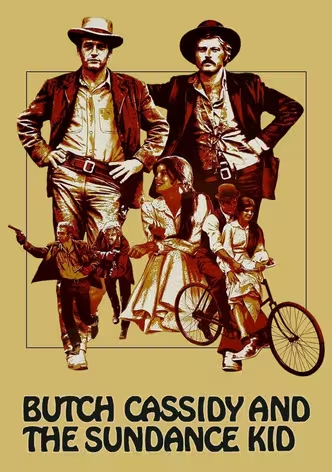
'Butch Cassidy and the Sundance Kid'
The Ringer's Bill Simmons, Sean Fennessey, and screenwriter and director Aaron Sorkin escape to Bolivia after a train heist gone wrong to rewatch the 1969 classic, 'Butch Cassidy and the Sundance Kid,' starring Paul Newman and Robert Redford, and written by William Goldman.
Cast
Paul Newman as Butch Cassidy
Robert Redford as The Sundance Kid
Katharine Ross as Etta Place
Strother Martin as Percy Garris
Cloris Leachman as Agnes
Ted Cassidy as Harvey Logan
Directed by: George Roy Hill
Written by: William Goldman
Cinematography by: Conrad Hall
Music by: Burt Bacharach
Notes
- William Goldman spent eight years writing the screenplay and was paid $400,000 for it – a record at the time. He only wrote three official drafts (though Sorkin notes screenwriters are 'not totally accurate' when counting drafts).
- Goldman revolutionized screenwriting by making scripts readable – before him, screenplays read like instruction manuals. He wanted the reader to approximate the experience of watching the film in a theater.
- The studio originally wanted Steve McQueen for Sundance, but McQueen and Newman couldn't agree on who got top billing. Goldman says McQueen wanted 'Steve McQueen in' before the title and 'with Paul Newman' after – Newman wouldn't accept that.
- This movie inspired both David Fincher to become a director and Aaron Sorkin to become a screenwriter. Sorkin says 'The Social Network' doesn't happen if this movie was never made.
- Goldman was offered the adaptation of 'The Godfather' but turned it down because he didn't want to glorify the mafia.
- Considered the first post-modern Western and the first modern buddy movie – it launched a whole genre that influenced 'Lethal Weapon', Turner & Hooch, and dozens of others.
- The Bolivia scenes were filmed in Mexico, where the entire crew got Montezuma's Revenge except Newman, Redford, and Katharine Ross, who were smart enough to only drink soda and beer.
- Katharine Ross clashed with director George Roy Hill and was banned from set for a day. Cinematographer Conrad Hall let her operate a camera during a scene; Ross and Hall later married.
- They tried to get Bob Dylan to sing 'Raindrops Keep Fallin' on My Head' – he declined. BJ Thomas sang it instead and it became the biggest hit of the year.
- Redford wanted to do all his own stunts, including running along the tops of train cars and jumping between them. Newman was upset about it, saying 'I won't lose a co-star'.
- Robert Redford hated the bicycle/musical interlude scene and thought it killed the movie the first time he saw it. It's now arguably the most iconic scene in the film.
Categories
The cliff jump – 'I can't swim!' 'Are you crazy? The fall will probably kill you.' Iconic moment that launched a thousand buddy-movie imitations. Also the bicycle scene with 'Raindrops Keep Fallin' on My Head' and the opening card game where we meet Sundance.
The dialogue – Goldman's screenplay is endlessly quotable and feels modern 50 years later. The buddy dynamic between Newman and Redford set the template for every buddy movie that followed. The humor holds up remarkably well.
Etta Place's character – she's basically the third wheel with unclear motivations. Did she love Sundance? Did she have feelings for Butch? In 1969 it needed no explanation why a woman would follow these guys around, but today it feels underwritten. Also the mock-rape scene with the bicycle is uncomfortable.
Steve McQueen was originally cast as Sundance before the billing dispute torpedoed it. Modern-day casting ideas: Ben Affleck and Matt Damon (Sorkin's pick – 'written by Aaron Sorkin, starring Affleck and Damon'), Clooney and Pitt, Leo DiCaprio and Ryan Gosling, Ethan Hawke as Butch, Ryan Reynolds as Butch.
Paul Newman – yes. Coming off Cool Hand Luke, this cemented him as the biggest star in the world at the end of the '60s. He could do whatever he wanted after this. Also George Roy Hill – he went on to have 20 straight years of beloved films including 'The Sting', 'Slap Shot', and The World According to Garp.
Strother Martin (Percy Garris) – the quintessential 'that guy' of '60s Westerns. Also George Furth (Woodcock), who was actually a playwright/writer but kept showing up in character roles. 'If Charles Grodin passes on something, George Furth gets the call.'
Act two is a very long chase sequence with minimal dialogue that feels slow by modern standards. Even Sorkin admits he'd want to tighten it in an editing room – 'I could take three minutes out.' The pacing conventions of 1969 filmmaking are the main issue for younger audiences.
Could work as a 10-episode Netflix series, but the movie might be too iconic – people would just be waiting for the famous movie moments and feel they got diluted. Same problem as remaking 'The Godfather'. Sorkin notes 'there is no sanctity in these things' and someone will eventually try it.
Who plays Butch and Sundance if you remake it today? Endless debate with no clear answer – every generation has candidates but nobody could fully escape the Newman/Redford shadow.
William Goldman. Won the movie 'hands down' – made a ton of money, set up his entire career, became the most famous screenwriter in Hollywood, and completely remodeled what a buddy movie could be. 'Of course it's Goldman.'