
'Do The Right Thing'
The Ringer's Sean Fennessey and The New York Times's Wesley Morris record this podcast on the hottest day in Brooklyn to rewatch the 1989 classic, 'Do The Right Thing,' starring Danny Aiello, Giancarlo Esposito, and John Turturro, and directed by Spike Lee.
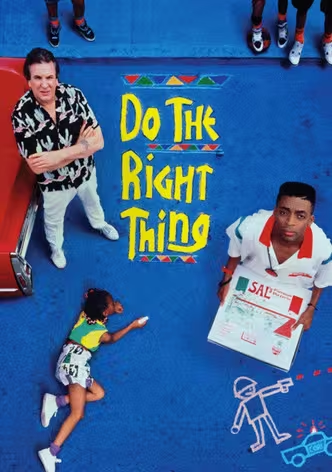
Cast
Danny Aiello as Sal
Giancarlo Esposito as Buggin' Out
John Turturro as Pino
Rosie Perez as Tina
Bill Nunn as Radio Raheem
Samuel L. Jackson as Mister Señor Love Daddy
Ossie Davis as Da Mayor
Ruby Dee as Mother Sister
Richard Edson as Vito
Robin Harris as Sweet Dick Willie
Martin Lawrence as Cee
Roger Guenveur Smith as Smiley
Frank Vincent as Charlie
Frankie Faison as Coconut Sid
John Savage as Clifton
Directed by: Spike Lee
Written by: Spike Lee
Cinematography by: Ernest Dickerson
Notes
- $6 million budget, earned $37 million at the box office – premiered at Cannes on May 19, 1989.
- Not nominated for Best Picture (the year Driving Miss Daisy won), which remains one of the most debated incidents in film criticism history. Got Oscar noms for Best Original Screenplay and Best Supporting Actor (Danny Aiello).
- Spike Lee wrote the screenplay in two weeks after being inspired by the Alfred Hitchcock Presents episode 'Shopping for Death' about hot weather increasing violent tendencies.
- Roger Guenveur Smith created the character of Smiley – the film's living metaphor – by showing up to set every day and begging Spike for a role. The character wasn't in the original script.
- Spike discovered Rosie Perez in a Brooklyn club and cast her despite her saying 'I'm not an actress.' She was choreographing the Fly Girls at the time, which included a young Jennifer Lopez.
- The production had only two pizzas for the entire shoot – John Turturro had to fake-cut with the pizza roller without going through the crust so they wouldn't destroy their props.
- The film's racial slur montage and 'you shoot me in a dream, you better wake up and apologize' line were both later borrowed by Tarantino for 'Reservoir Dogs' and 'True Romance' – a sore point in the Spike-Tarantino feud.
- The street's color scheme was heavily altered by the production designer using red and orange paint to convey the heat wave.
- During filming, crack dealers threatened the crew for disturbing their business, so Spike hired Fruit of Islam members for security.
- Barack and Michelle Obama went to see this film on their first date.
Categories
Quote from Rog's review:
“Spike Lee had done an almost impossible thing. He'd made a movie about race in America that empathized with all the participants.”
Ebert wrote: 'I have been given only a few film-going experiences in my life to equal the first time I saw Do the Right Thing. Most movies remain up there on the screen. Only a few penetrate your soul.' Sean calls it Ebert at the top of his game.
Rosie Perez's opening dance to 'Fight the Power,' Buggin' Out and the Wall of Fame confrontation, the fire hydrant scene with Frank Vincent, Sal and Pino's debate about selling the pizzeria, the racial slur montage, and the devastating final sequence. Wesley picks Rosie Perez's opener; Sean picks the ending.
Public Enemy's 'Fight the Power' (written specifically for the film by Chuck D at Spike's request), the film's timelessness as a philosophical text on race in America, Ossie Davis and Ruby Dee as a salty love letter to their real-life love, Spike Lee as movie star, Danny Aiello's powerhouse performance, Robin Harris as Sweet Dick Willie, Ernest Dickerson's cinematography, and the direct-address camera style that Wes Anderson and the MTV revolution jacked.
Rosie Perez's acting – it's her first movie and you can tell. More significantly, the nude/ice cube scene and Perez's later comments about being uncomfortable filming it: 'the atmosphere wasn't correct.'
Spike Lee campaigned for Robert De Niro as Sal, but De Niro had to decline due to prior commitments. Wesley argues it would have been a morally different movie – De Niro would have tipped the engagement balance and audiences might have cheered Sal smashing the boom box because it's De Niro.
Wesley picks the white guy in the Larry Bird jersey who gets his Air Jordans stepped on by Buggin' Out. Other nominees: Bill Nunn as Radio Raheem, Robin Harris, Rosie Perez, Samuel L. Jackson, Martin Lawrence. John Savage used to tell a fake story about Larry Bird giving him the jersey through his sister – Spike debunked it on camera.
Spike got the idea from an Alfred Hitchcock Presents episode about hot weather and violence. Wrote the screenplay in two weeks. Original ending had a stronger reconciliation between Mookie and Sal. Shot entirely on Stuyvesant Ave between Quincy St and Lexington. Crack dealers threatened the crew, so Spike hired Fruit of Islam for security. Samuel L. Jackson slept most of the time on set since he had no outdoor scenes. Obama first date was seeing this film.
Spike Lee – the apex of his filmmaking powers. Wesley says absolutely yes, 100%. Also Danny Aiello's best performance. John Turturro discussed but his apex is probably Barton Fink.
Frank Vincent wins because it's always Frank Vincent. Other nominees: Frankie Faison (later known from The Wire), Roger Guenveur Smith, Miguel Sandoval. Giancarlo Esposito used to be the winner of this category until Breaking Bad made him a star.
Sean picks Giancarlo Esposito's Buggin' Out – purposefully over the top but sometimes losing subtlety. Wesley picks Ruby Dee's Mother Sister, specifically the 'burn it down' moment.
Did Mookie throw the trash can to save Sal or to express his rage? Why is Pino so angry? How long before Mookie and Sal patched things up? Did Mother Sister and Da Mayor bone? Did Tina and Mookie stay together? (Sean says no way.) Was Sal's pizza actually good? (It looked like Play-Doh – they only had two pizzas for the whole shoot.)
Spike Lee. Wesley says it made his career, it's one of the greatest movies America has ever produced, and people will be watching it in 100 years. It's a perfect movie about an imperfect problem that America will never solve.