
'Inception'
The Ringer's Jason Concepcion, Mallory Rubin, Sean Fennessey, and Andrew Gruttadaro dream big and embark on the ambitious task of recording a podcast within a podcast within a podcast to capture the essence of 'Inception,' Christopher Nolan's 2010 visual spectacle starring Leonardo DiCaprio, Ellen Page, and Joseph Gordon-Levitt.
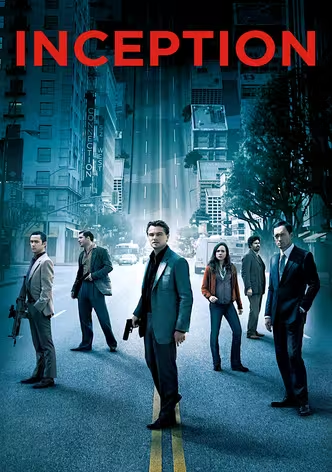
Cast
Leonardo DiCaprio as Dom Cobb
Joseph Gordon-Levitt as Arthur
Tom Hardy as Eames
Cillian Murphy as Robert Fischer
Marion Cotillard as Mal
Elliot Page as Ariadne
Ken Watanabe as Saito
Tom Berenger as Peter Browning
Michael Caine as Miles
Pete Postlethwaite as Maurice Fischer
Lukas Haas as Nash
Directed by: Christopher Nolan
Written by: Christopher Nolan
Cinematography by: Wally Pfister
Music by: Hans Zimmer
Notes
- The hosts open by calling Nolan 'hashtag overrated' – a consensus take that still acknowledges 'Inception' as one of his two truly great movies (the other being 'The Dark Knight').
- Nolan is colorblind, which the hosts note must affect his visual palette – his films are heavy on slate grays, whites, and blacks with very little primary color.
- The movie is deeply self-reflexive about filmmaking: Cobb is the director, Arthur is the producer, Ariadne is the production designer/architect, Eames is the actor (forger), Fischer is the audience, and Saito is the studio executive. There's even a scene where Cobb (the director figure) yells at Arthur (the producer figure) for not doing enough research.
- Mallory has a false memory of seeing 'Inception' in college and discussing it in her dorm room – but the movie came out two years after she graduated. She attributes this to the film's 'hits blunt once' quality of dorm room philosophy.
- Pete Postlethwaite (Maurice Fischer) was diagnosed with pancreatic cancer in 2009 and died six months after the film's release, eerily mirroring his character who is dying in the movie.
- Marion Cotillard won her Oscar playing Edith Piaf in La Vie en Rose, and Nolan then cast her in 'Inception' where 'Non, je ne regrette rien' (Piaf's signature song) is used repeatedly as the kick music – a strange meta-reference the hosts find notable.
- Mallory notices the line 'You're waiting for a train' is delivered differently in two key scenes: Mal says 'don't know for sure' (representing present uncertainty) while Cobb says 'can't know for sure' (representing rational impossibility) – she argues this reflects the difference between Mal as a projection of guilt vs. Cobb's rational mind.
- Nolan first pitched 'Inception' in 2001 after 'Memento' but felt he lacked the experience – so he went and made the 'Batman' trilogy partly to gain the skills to pull off this production. His original treatment was 80 pages long.
- The zero-gravity hallway fight was achieved with a 100-foot-long rotating corridor suspended on eight concentric rings powered by two electric motors. Originally planned at 40 feet, it was expanded to 100.
Categories
Don Johnson was considered for the role of Peter Browning (played by Tom Berenger). The hosts note Johnson has a 'ruined man quality' that would have worked, but Browning isn't the most essential character.
- The snow fortress heist (third dream level) – Mallory loves the snowmobiles and the Avalanche. Despite lacking the emotional weight of the Cobb/Mal scenes, it feels like a pleasant relief from tracking the complexity.
- The training scene in Paris where Cobb shows Ariadne how dreams work – the exploding newsstand, the folding city. Andrew calls it 'pretty incredible' and 'masterful mind-blowing stuff.'
- The zero-gravity hotel fight – Sean says it holds up really well. 'I have no idea how he pulled that off.'
- The Cobb and Mal scenes – the elevator of memories, the limbo train reveal. Mallory finds these the most emotionally gripping.
- Tom Hardy not wearing a mask and speaking with a normal human voice – Jason notes this is rare in Hardy's subsequent career.
- Joseph Gordon-Levitt in a suit – the hosts want to see more of him in suits.
- The set pieces in general – a $150 million original movie about dreams getting made feels increasingly impossible in today's IP-dominated landscape.
Dreams in general as a movie subject – Sean notes that for a filmmaker 'not that visually interesting all the time,' Nolan's dreams sometimes 'just look like an ad for suits.' Compared to the wild imagery of Dreamscape (1984), Nolan's dream worlds could be more creative.
- Nolan first pitched the film in 2001 after 'Memento' but realized he didn't have the experience for a production of this complexity.
- His original treatment was 80 pages – essentially script length – because the concept needed extensive clarification for producers.
- For the zero-gravity hallway, the filmmakers built a 100-foot rotating corridor (originally planned at 40 feet) suspended on eight concentric rings powered by two electric motors.
- The movie was influenced by late '90s/early 2000s 'mindfuck' films: The Matrix, Dark City, The 13th Floor.
- Tom Hardy as Eames – cast after Nolan saw him in RocknRolla. Hardy thought he was being cast in a small movie; when he got to set he realized the scale. Jason calls him 'the answer.'
- Lukas Haas as Nash – cast as a favor to his friend Leo. 'It's a flex of incredible proportions by Leonardo DiCaprio.' The hosts debate whether he was on set for one day or a week.
- Hans Zimmer's score – Andrew nominates it but the hosts debate whether Zimmer is 'more than a role player.' His music dominates scenes to the point of being physically loud.
- The dorm room philosophy of the movie itself – 'It's the literal version of hits blunt once.'
- Sean picks Wally Pfister – the cinematographer who 'went on to become a filmmaker in his own right, and not a terribly successful filmmaker.' But the Paris folding scene and dream sequences are 'masterful mind-blowing stuff' largely due to how they're shot.
- Andrew picks Joseph Gordon-Levitt – 'Where's he been? What's he doing?' After 'Inception' he did Lincoln, Snowden, and Looper, then largely disappeared into his company HitRecord.
- Jason picks Christopher Nolan – 'After this movie came out it certified Nolan' as something bigger than a 'Batman' director. He started getting the 'Spielberg of our time' title.
- Mallory picks Tom Hardy – 'extremely dashing and handsome' with perfect line readings. 'It's really the last time we're allowed to see how handsome he is.'
- Is Dom Cobb dreaming at the end? Sean says yes but doesn't care – 'it doesn't matter.' Mallory finds the wobbling totem infuriating: 'That's such a filmmaker gotcha. If the camera goes with him to his kids and you never see the wobble, then it's about the relationship.'
- The theory that Ellen Page's Ariadne was sent by Michael Caine's character to infiltrate Cobb's subconscious and get him to admit to Mal's murder – she's not just an audience surrogate but an interrogator.
- Why can't Cobb see his kids' faces? Jason offers a charitable explanation about the difference between projections and memories – the kids not turning is a real moment frozen in time, not a projection.
- How does Saito have the power to clear a murder charge with one phone call from a plane? 'What part of the game is that?'
- Why not just fly the kids to France instead of the whole inception scheme?
- The kick logic is inconsistent – if the van flipping should create a falling sensation, everyone should have woken up, not just experienced zero gravity on the next level.
- Michael Caine's character has a completely different accent than his daughter (Marion Cotillard) with no explanation.
- Leo sniping people with perfect accuracy in the snow level strains credulity (though 'it's a dream' is the catch-all defense).
- The customs scene at the end – 'That's not what customs looks like.' Saito makes one phone call and Cobb walks through with a wave.
- Sean picks Christopher Nolan – this movie proved he could make a non-IP original blockbuster. 'A lot of people can make money making 'Batman' movies... it's really hard to make a movie that makes money that's about dreams.'
- Andrew picks Tom Hardy – 'extremely dashing and handsome, his line readings are perfect, every scene he's in he's the center even if he's not supposed to be.'
- Mallory picks Nolan – 'It's actually interesting that this is a Leonardo DiCaprio movie that people don't really think of as a Leonardo DiCaprio movie. It's a Christopher Nolan movie.'
- Jason picks the moviegoing audience – 'This is high-level creative moviemaking... a non-IP movie about dreams, made a lot of money, came out in the summer, was a blockbuster. Will we ever see that again?'